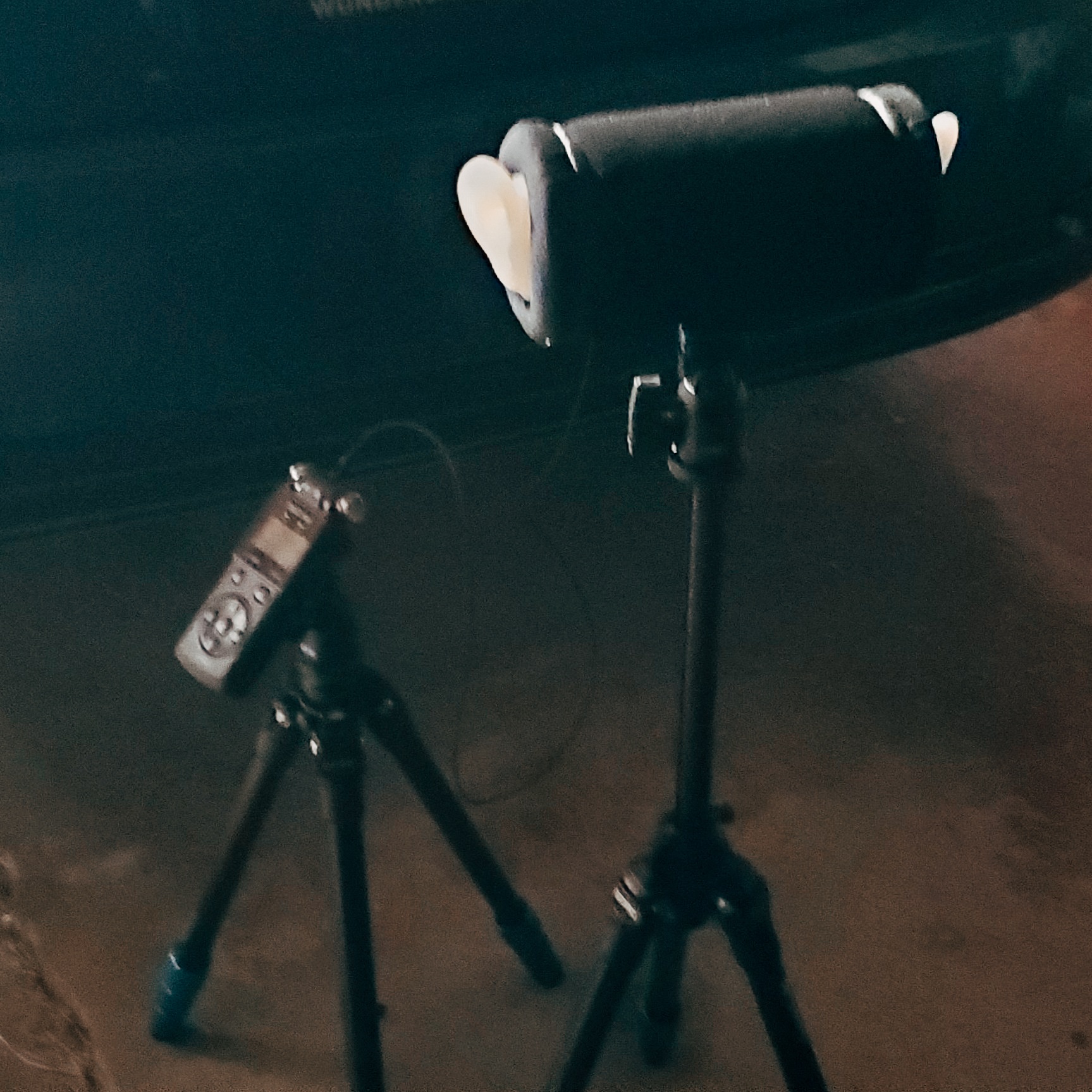
It is easy to both over- and under-process field recordings. Each has drawbacks, and a skilled recordist balances both while keeping the sound realistic and taking inspiration from others, but never copying.
Last Updated: 29-September-2026
Keeping Binaural Field Recordings Realistic in Post-Processing
I have been experimenting with post-processing my binaural field recordings and have changed my mind about some of the effects I used to think were necessary.
The overall goal is simple: when I play back a binaural recording through headphones, I want it to sound like I am back in the place where I recorded it. I do not want it to sound like a heavily processed music track. I want the low end to give a sense of the size of the place, and the high end to give directionality and space.
I have found that binaural recordings can be improved in post-production, but they can also be ruined very easily.
The trick seems to be to do less.
Why Binaural Recordings Are Easy to Ruin
Binaural recordings work because the microphones capture tiny timing, level, and frequency differences between the left and right ears. These differences tell the listener where things are in space.
For example, a bird to the left will arrive at the left microphone slightly earlier and louder than it arrives at the right microphone. Higher frequencies are also shaped by the ears and head of the listener or binaural microphone setup. These details help the brain determine whether a sound is in front, behind, above, below, near, or far away.[arxiv][audiouniversityonline]
This is why binaural recordings can sound so amazing through headphones. But it is also why stereo effects, heavy equalization, tape emulation, saturation, and other processing can make the recording sound less real.
In some cases, I found that the more “interesting” I made the recording with plugins, the less binaural it became.
The Low End Gives the Recording Weight
One thing I have learned is that the low end is important in field recordings.
Low frequencies can give a recording weight and make the listener feel that they are in a real, wide, physical place. Distant traffic, wind, weather, water, and other low-frequency environmental sounds can make a recording feel grounded.
If I cut too much of the low end, the recording begins to sound shallow. It loses some of its depth and sense of location.
But not all low-frequency sound is useful. Wind buffeting the microphones, handling noise, subsonic rumble, and strange pulsations are not what I heard when I was actually standing in the field. These need to be reduced.
For this, I generally prefer a gentle low shelf rather than cutting everything out with a high-pass filter. A small low shelf reduction lets me keep the weight and depth of the recording while reducing distracting rumble.
Usually, I start with a low shelf around 90 Hz and listen carefully. The amount depends on the recording. Sometimes I need nothing. Other times, a few dB of reduction helps a lot.
Additional Low-End Lessons and Observations
I’ve observed a few more low-end items that I think are worth mentioning here and may be helpful for you.
- Binaural recordings tend to have more low-end to them than shotgun mic recordings or A-B setups, and this is probably due to the directionality aspect of the microphones. Binaural microphones are typically omnidirectional but guided by the ear canal (either real or fake), and this means they are picking up everything in all directions ear-outward, whereas shotgun mics, for example, are highly directional and may be only getting the rain hitting a roof or a bird in a tree, for example.
- Low-end doesn’t really matter as much as you may think it does. Yes, it does give a better sense of place, but that is only if the place itself has a low end. Some remote areas with little wind will not. Rural areas with distant highways, for example, will have a prominent low-end. But, guess what, if you don’t like that highway, you can low-shelf it right out of existence if you want, and presto, you’re in a secluded area with no highways, just like that.
- The low-end of a recording is usually very rumbly and distracting, and you have to be careful when dealing with it. I often need to low-shelf it out of existence, but that frequency varies by the material. I have some recordings of deep, deep thunder that I need all of the low-end I can get, but it is rumbly when nothing is happening, so I low-shelf about 3-4 dB around 37 Hz with a gentle slope, and I don’t lose my thunder, but I clear out all of that low rumble. If I need to go higher than 40 Hz, I use De-Wind with a 200 Hz crossover frequency. Don’t do both. And with De-Wind, listen for that warbly sound of too much smoothing and back it of or switch to EQ instead if it’s a problem.

Low-Shelf to Clear Rumble
…or…(not and)…

De-Wind to Remove Rumble
The High End Gives Directionality
The higher frequencies are where much of the directionality and binaural effect comes from. Small sounds such as insects, leaves, birds, rain, distant machinery, and movement around the microphones give the listener information about where they are in space.
I have found that I should be very careful with the high frequencies. Do not mess with them at all if possible.
A recording can sound smoother after a high cut or tape emulation, but it can also become less realistic. The sound may become more pleasant in a conventional mixing sense, but the feeling of being in the location can totally disappear.
So I generally do not do broad high-frequency cuts on binaural field recordings. If there is a harsh noise or hiss that needs attention, I try to remove it surgically rather than rolling off all of the high end.
The goal is not to make the recording sound “warm.” The goal is to keep the directional information intact.
If I do use EQ, I make sure it is L-R linked (changes to both channels at once) to preserve the binaural realism.
Restoration First
My first step is still to make an archival master in iZotope RX.
See my article on this: Master Field Recording: Post-Processing Techniques for Field Recordings
I use as little processing as possible. Some recordings need only a small gain increase and a little equalization. Others need much more work.
The key is to remove things that are not part of the location, while keeping the actual sound of the location.
Post-Processing Enhancements That Did Not Work for Me
I have tried a number of things on binaural field recordings that I like on music, but they did not give me the result I wanted here.
Tape and Sampler Emulation
I like tape and sampler emulation in music. I have used U-he Satin and Inphonik RX950, among other plugins, to add warmth, age, grit, and character.
But on my binaural field recordings, I found that these effects reduced the realism.
Tape emulation can soften the high end, alter transients, add low-frequency head bump, introduce noise, and blur stereo details. Sampler emulation can reduce bandwidth and add aliasing or other artifacts. These effects may sound good creatively, but they can weaken the tiny details that make binaural recordings feel like real places.
I may still use them for a creative treatment or as part of a music track. But for a realistic binaural field-recording master, I am leaving them out.
Stereo Widening and Crosstalk
I also avoid stereo widening, crosstalk, chorus, Haas-style delays, and most Mid/Side processing.
The binaural recording is already wide. It already has spatial information that was captured in the field. Trying to widen it further often changes the location of sounds or makes the image less stable.
The point is not to make the recording wider. The point is to keep it believable.
Compression
I do not think most field recordings need compression.
Compression can raise the background noise and make insects, wind, and ambience pump when a louder sound occurs. This is especially noticeable in quiet night recordings.
For my archival masters, I want dynamic range. For my creative masters, I may use a final limiter to bring the recording to an appropriate loudness, but I do not want to flatten the recording into a constant wall of sound.
I’ve tried with upward compression also and it only brings up the hissing background for me. So I leave compression right out of the equation.
Independent Channel Processing
Anything that processes the left and right channels separately will not work and it will ruin the binaural effect entirely. Likewise, mid and side processing will also ruin the binaural effect.
Post-Processing Enhancements That Do Work for Me
Simpler is better, I found.
A Little Reverb Can Help
This was surprising for me.
Binaural recordings sometimes sound like they are occurring inside the listener’s head.
This is due to a very interesting but non-intuitive effect that was explained to me in the book “Wild Soundscapes” by Bernie Krause. In the Appendix, there is a section titled “Binaural Recording Issues” by Lang Elliott that explains the issue.
Binaural recording itself preserves the tiny timing, level, phase, head-shadow, and outer-ear (pinna) cues that your brain normally uses to locate sounds. But, as Lang Elliott explains in the appendix to Bernie Krause’s Wild Soundscapes, headphones deliver each channel extremely close to its respective ear and with unusually complete left/right isolation. That can make the brain interpret certain sounds–especially those recorded directly front and center—as being located inside the listener’s head rather than out in front in the real soundscape.
This is not necessarily a failure of the recording: it is a playback-perception limitation. On loudspeakers, channel crosstalk destroys many binaural localization cues; on headphones, the lack of natural acoustic interaction between the two ears and the physical proximity of the drivers can produce excessive internalization. Elliott describes a practical remedy: use a physical barrier between the ears during headphone listening, which reduces cross-ear leakage in a way that can restore a much wider, more externalized sound field. But that is not so practical.
For field recording, the practical takeaway is that a binaural capture can have strong lateral depth and realism while still leaving centered material like distant straight-ahead birds, a stream ahead, voice, or wind in front feeling “in-head.” Gentle crossfeed, binaural-room simulation, or careful monitoring choices may help externalize it, but they also trade away some of the precise binaural separation.
I’ve found that a small amount of well-chosen reverb can help a binaural recording feel less “inside the head” by adding the subtle early reflections and diffuse spatial information that tell the brain a sound exists in an external environment. Keep the original binaural recording dominant so its real left/right timing, level, and spectral cues remain intact; use a quiet, natural-sounding stereo or binaural reverb—not a mono, identical signal in both ears—to give forward or centered sounds a little surrounding air and distance. For example, a subtle short reflection field behind a centered bird call can make it seem located a few meters ahead in the woods rather than between the listener’s ears, without sacrificing the recording’s authentic spatial realism.
I did this and found that adding a very small amount of reverb (about 12%) can make the recording sound more external and more like it is happening around the listener instead of in-the-head.
I have tried different kinds of reverbs. The one that works best for me is Chameleon, using a convolution-style space that I copied from the rain scene in Blade Runner, which was outdoors in the rain. It is possible that the rain caused some of the magic of this particular reverb by imprinting itself on the impulse response.

The important part is that the reverb is very subtle. I am currently using around 12% wet. At this level, I do not really hear “reverb” as an effect. Instead, when I bypass it, the recording seems flatter and more inside the head. When I turn it back on, it feels slightly more open and natural.
Early reflections are particularly important here. They can give the brain information about space and distance without needing a large reverb tail.
I prefer short, natural-sounding spaces. Large halls, plates, springs, shimmer reverbs, and obvious effects usually make the recording sound less like the original location. I try to make the convolution part of the reverb match whatever location I am recording. So outdoors in the rain from Blade Runner works quite well because the scene is filled with white noise from the rain, which covers all frequencies, and it is close-reflected because the rain is near the listener.
The reverb should not become the new location. It should only help the listener hear the existing one.

A Little Imaging Can Help
Definitely, imaging (a.k.a. stereo enhancers) can ruin a binaural recording, but within a layered track where the binaural recording underlies other instrumentation, I find it acceptable to have small amounts of image enhancements.
Low end, for example, needs a bit of grounding and bringing it closer to mono is totally acceptable. Also, the low mids can always use some enhancement since they are right next to the lows and this provides needed contrast. High mids I leave alone and the highs I enhance slightly. This works for me. Try different schemes on your own recordings and listen for that breakdown of the binaural and adjust accordingly to avoid it.

What I find is this:
| Band | Approx. range | Setting | Likely effect |
|---|---|---|---|
| 1 | Below ~100 Hz | Width about –31 | Pulls the deepest bass distinctly toward mono |
| 2 | ~100–300 Hz | Width about +17 | Restores/modestly increases spaciousness in lower ambience and resonance |
| 3 | ~300 Hz–9 kHz | Around 0 | Preserves the original binaural relationship through most of the localization-critical midrange |
| 4 | Above ~9–10 kHz | Width about +6 | Adds a very subtle lift to air, fine texture, and diffuse openness |
Psychoacoustic Processing
This was surprising also.
It sounds like magic, but MAAT Digital has a psychoacoustic processor named FiDefJenTwo that can really bring out the detail in a recording and make it feel “live.”
I’ll leave it to them to explain how it works in part, but it is a proprietary thing so don’t expect a detailed description. In any case, the Sutro setting really seems to work for me.
MAAT Digital’s FiDef JENtwo works by adding, not EQ’ing, compressing, widening, or otherwise directly altering, the source with an extremely low-level, dynamically changing, source-correlated, spectrally shaped anharmonic broadband signal. It is basically a program-dependent noise.
MAAT describes this as a psychoacoustic stimulus intended to increase perceptual attention and engagement. In practice, it can make a good binaural field recording seem more immediate, detailed, dimensional, and “lit from within,” allowing low-level natural cues such as leaf movement, distant insects, water texture, air, and subtle spatial changes to register more readily without obviously changing the recording’s tonal balance or stereo geometry.
Because it is additive and deliberately near or below audibility, it can preserve authentic binaural location cues better than aggressive enhancement, and the result is subtle and program- and listener-dependent, so it is best judged with level-matched bypass comparisons after listening for a minute or two, rather than by expecting an obvious effect.
I place this plugin after my limiter but before my dither.
You’ll have to try it to see if it does anything for your recordings, but for mine it seems to be a game-changer.

A High-Frequency Focused Ultra-Transparent Limiter
Another non-obvious thing that really makes a difference is a special kind of limiter called a high-frequency limiter. This one keeps a listener engaged.
It works because blocking some of the high-frequency sounds of a field recording can keep the listener listening for a longer period. This is because high-frequency sounds over long periods can be fatiguing. The brain picks up on this and tells the listener to stop listening.
I’ve tried this, and it really happens. I used a field recording of insects at night, and it was definitely noticeable, as you would expect, but it worked equally well with a quiet spring night track. I got tired of listening to these tracks when I did not use a high-frequency limiter.
The plugin I used for this special limiting was called Limen by Ohlhorst Digital.
Limen is Ohlhorst Digital’s high-frequency acceleration limiter: a mixing and mastering plug-in designed to tame sudden, harsh high-frequency changes without simply turning down the whole top end. It splits off frequencies above a chosen crossover, detects rapid high-frequency “acceleration” rather than relying on a fixed level threshold, and applies adaptive control; its Depth, Tilt, and Recover controls let you decide how strongly it acts, where in the treble it concentrates, and how much tonal brightness is restored afterward. In short, it aims to give you the smoothness associated with tape-like high-frequency behavior while retaining detail and overall timbre; “limen” is Latin for “threshold.”
Ohlhorst Digital’s Limen can help field recordings by gently controlling the most abrupt, fatiguing high-frequency events such as wind bursts, insect stridulation, close bird transients, leaf crackle, water sparkle, rain ticks, or sharp digital edge, without broadly darkening the entire recording as a shelf EQ or conventional limiter might.
Instead of reacting to signal level alone, it isolates audio above a chosen crossover and responds to rapid high-frequency waveform changes (“acceleration”), which are often where perceived sharpness lives. The lower band passes through unprocessed and the linear-phase crossover is designed to reconstruct cleanly. Used subtly, that lets you retain a recording’s air, delicate detail, and binaural spatial cues while making the top end less abrasive and easier to listen to for long durations.
I experimented quite a bit until I came up with the right settings.

With the settings I use, Limen is functioning as a very gentle upper-mid/high-frequency smoothing stage rather than an aggressive treble limiter where it is processing in L/R, linked stereo, with the crossover set around 4–5 kHz, a slightly positive Tilt, moderate Depth around 4, and a Recover around 150% which the plugin says “push the spectral balance further, adding a silky quality to the high frequencies that conventional EQ cannot achieve.” They’re right too, by the way.

For me, the Limen preset I developed has a particularly sensible configuration for binaural field recordings because it leaves the low and midrange body, and therefore much of the environmental weight and spatial foundation, largely untouched, while catching the fast, sharp high-frequency changes that make wind, leaves, water sparkle, insect activity, rain, and close bird calls feel piercing or digitally brittle.
The slight positive Tilt concentrates control higher in the affected band, so it can soften glare while retaining lower-presence detail and intelligibility; linked L/R processing also helps preserve the recording’s stereo stability by avoiding arbitrary left/right level shifts.
The result does not have less of anything, but it does have a smoother, more natural top end that can reveal low-level ambiance and make extended headphone listening more comfortable without stripping the open, detailed realism of the original recording.
Another great feature of this plugin is that level going into it doesn’t matter so there’s no gain staging to do to make this one work. It is really effective and I highly recommend you try it.
My Process and Chain of Effects
My Current Binaural Field Recording Chain
For a natural binaural presentation master, my current approach is simple:
- Izotope RX restoration: Master Field Recording: Post-Processing Techniques for Field Recordings
- Minimal linked linear phase stereo EQ, only if needed.
If I use it at all, I make sure that EQ is applied evenly to both channels. I avoid separate left/right EQ and most Mid/Side processing because I do not want to alter the spatial relationships that were captured by the binaural microphones. - Chameleon convolution-style reverb at about 12% wet
- Final loudness and true-peak limiting
- Psychoacoustic processing
- 24-bit WAV export
A Simple Test I Do
Here is the test I now use:
- Does the effect make the recording sound more like I was there?
- Does it preserve the location of birds, insects, vehicles, wind, and distant sounds?
- Does it make the recording more external on headphones?
The best result is when I turn off the effect and miss it, but turn it on and do not hear it as an effect.
My Conclusion on Effects Processing
I used to think I needed tape, saturation, sampler effects, equalization, widening, and other processing to give field recordings character.
Now I think the character is already there.
The location has its own tone. The weather has its own texture. The microphones have captured details that I may not even notice until I listen carefully through headphones.
My job in post-processing is not to replace those things. It is to remove distractions, preserve the useful low-frequency weight, retain the high-frequency directional information, and make the presentation just slightly more natural for headphone listening.
For now, that means RX restoration, very limited EQ, a small amount of Chameleon reverb, then Limen, my limiter, then FiDef and dither.
Making Field Recordings Stand Out: Realism, Perspective, and Creative Choices
There are more field recordings available now than ever before.
A person can open YouTube, Bandcamp, SoundCloud, a sound-effects library, or a streaming service and immediately find recordings of rain, forests, city streets, trains, beaches, insects, birds, and wind. Many of them are very good.
So I have been thinking about what makes a field recording stand out.
For me, the answer is not necessarily more processing or more unusual effects. I think the most interesting recordings are often the ones that make the listener feel like they are actually somewhere else.
I want a person wearing headphones to feel that they are standing in the woods, near a river, beside a road at night, or in the middle of a particular room. I want the small details to remain intact: insects moving around the listener, a vehicle passing in the distance, wind in a specific type of tree, changes in weather, and the low-frequency sound of the larger world beyond what is immediately visible.
My goal is ultra realism.
This does not mean every recording has to be completely unprocessed or documentary in style. It simply means that realism is the foundation. Once I have a believable recording, I can decide whether I want to preserve it as a soundscape or transform it into something more musical.
Start With a Real Place
The easiest way to make a field recording sound different is to record somewhere that actually has character. This doesn’t have to be exotic – it can be your own backyard.

This sounds obvious, but it is easy to focus too much on microphones, recorders, plugins, and settings. Equipment matters, but location usually matters more.
A good location has its own acoustic identity.
It might have:
- A particular kind of wind moving through trees
- Insects that create a distinctive high-frequency layer
- Distant traffic or machinery that gives the place scale
- Water, rocks, bridges, hills, tunnels, or buildings
- Birds that call from different distances and directions
- A mix of near, middle, and far sounds
- A quiet period that allows small details to emerge
A quiet country night may not seem dramatic at first. But when I listen carefully, it can contain insects, wind, distant roads, occasional animals, electrical hum from far away, and other small sounds that make the place feel alive.
The recording stands out because the place stands out.

Record Longer Than You Think You Need To
One thing that makes field recordings more useful and more interesting is patience.
Many of the best moments happen after I have stopped expecting them.
A bird may move close to the microphones. The wind may change direction. A car may pass at exactly the right distance. A sudden quiet moment may reveal insects or distant sounds that were previously masked.
If I only record for a few minutes, I may capture the obvious sound of the location. If I record longer, I may capture the location changing.
This is especially important for ambience recordings. The changes may be subtle, but they are what make the soundscape feel real.
Use Binaural Microphones for Presence
I use binaural microphones because I want the recording to feel like a listener is present in the space.
Here is the equipment I use: Master Field Recording: Recommended Binaural Microphones
Binaural recording captures small differences between the left and right ears. These differences include timing, level, phase, and high-frequency filtering caused by the head and ears. When played back through headphones, these details can make sounds appear in front, behind, above, below, near, or far away.
A bird moving from left to right should not just pan across the headphones. It should feel like it is moving around the listener.
A distant truck should not just sound quieter. It should feel like it is far away.

This is why I try to preserve binaural information in post-processing. I avoid effects that make the recording wider, softer, or more “produced” at the expense of the actual spatial information.
The microphone setup is not a special effect. It is the perspective of the recording.
Find the Right Perspective
The same location can sound completely different depending on where the microphones are placed.
For example, a forest can be recorded:
- Near the ground, with insects and leaves close to the microphones
- At head height, where the listener feels like they are standing in the location
- Near a stream, where water becomes the central element
- At the edge of the forest, where distant traffic becomes part of the soundscape
- Deep inside the trees, where the outside world becomes quieter
There is no single correct perspective.
The important thing is to make a decision. Before recording, I try to ask: Where should the listener feel that they are standing?
That question helps me decide where to place the microphones, how long to record, and what I want the finished recording to communicate.
Capture a Full Frequency Range
The low frequencies and high frequencies both matter.
Low frequencies give a recording weight. They can make a location feel large and physical. Distant traffic, wind, ocean waves, large machinery, thunder, water, and the resonance of buildings or landscapes can all create a low-frequency foundation.
High frequencies give a recording detail and directionality. Insects, leaves, small birds, rain, grass, branches, and close movement help the listener understand where they are in the space.
It is tempting to remove too much low end because wind and rumble can be distracting. It is also tempting to soften the high end because hiss, insects, and sharp details can become tiring.
But if I remove too much from either end, the recording can lose its sense of place.
I try to remove only things that do not belong: microphone wind noise, handling noise, electrical problems, clicks, or other technical distractions. I do not want to remove the natural weight and detail that make the recording believable.
Let the Source Do the Work
I used to think that a recording needed a lot of processing to sound distinctive.
I experimented with tape emulation, sampler emulation, equalizers, saturation, stereo effects, compression, and other tools. These can all be useful in music. They can also be useful if the goal is to turn a field recording into something abstract.
But I have found that the more processing I use on a binaural field recording, the more likely I am to lose the thing that made it special in the first place.
The location is already a complex sound design system.
The wind is a synthesizer. The insects are a high-frequency texture. Distant traffic is a low-frequency drone. Birds are unpredictable melodic events. Water provides rhythm. Architecture and landscape provide reflections.
My job is not necessarily to add more character. It is to capture the existing character well.
Make It Stand Out Through Editing
A field recording does not have to be released exactly as it was recorded.
Editing can make a large difference without making the recording feel artificial.
I often look for:
- The strongest beginning and ending
- Sections with a good balance of near and distant sounds
- Moments when an unexpected sound changes the recording
- Long quiet sections that allow the listener to settle into the space
- Sections with less microphone wind or handling noise
- Repeated sounds that become distracting over time
Sometimes a recording is better as a ten-minute piece than a forty-minute piece. Sometimes the opposite is true. It depends on whether the soundscape has enough subtle variation to hold attention.
The goal is not to make the recording shorter just because people have short attention spans. The goal is to let the location reveal itself at the right pace.
Use Processing to Support the Recording
Processing should support the field recording, not replace it.
For my realistic binaural masters, I now use a simple approach:
- Restore technical problems in RX.
- Use minimal linked stereo EQ only if needed.
- Add a small amount of Chameleon convolution reverb if it improves headphone externalization.
- Apply final loudness and true-peak limiting.
- Export a high-resolution master.
The reverb is subtle. I am currently using around 12% wet. If I clearly hear “reverb,” then it is probably too much.
The goal is not to put a forest inside a cathedral or make a quiet night sound cinematic. The goal is to make the listener feel slightly less like the sound is inside their headphones.
Ideas for Your Recordings to Stand Out
Not everyone has to pursue ultra realism. There are many good ways to make field recordings distinctive.
Record a Personal Geography
Record the places you know.
A local park, backyard, bus stop, train station, riverbank, apartment building, factory area, or neighborhood can become more interesting when recorded over time. Returning to the same place in different seasons, weather conditions, and times of day can create a personal archive.
The recordings become distinctive because they are connected to a real life and a real place.
Choose an Unusual Listening Position
The listener does not always have to be standing at normal head height.
Try recording:
- Close to the ground
- Under a bridge
- Inside a parked car
- Near a window during a storm
- In a stairwell
- Beside a heating vent
- At the edge of water
- Near a fence, wall, or other reflective surface
- In a location before and after people arrive
A small change in perspective can turn a familiar sound into something new.
Record Time, Not Just Sound
Some of the most interesting recordings are recordings of a change.
Try recording:
- The transition from day to night
- A storm arriving or leaving
- A train station gradually filling up
- A city street after rain
- Morning birds beginning before sunrise
- An area becoming quiet after an event
- Seasonal changes in the same location
A recording can stand out because it documents a specific moment in time, not just a general type of sound.
Use Constraints
Creative constraints can help.
You could decide to record only at night, only in winter, only within walking distance of home, only with one microphone setup, only near water, or only in places where human and natural sound overlap.
The constraint gives the project a shape. It also helps listeners understand what connects the recordings.
Create Two Versions
Another possibility is to create two versions of the same recording:
- A natural or archival version that preserves the location.
- A creative version that transforms it with processing, editing, looping, reverb, sampling, or music.
This gives the listener a choice. It also allows the original field recording to remain available even if you decide to experiment.
Stand Out Through Restraint
I think one of the easiest ways to make a field recording stand out now is simply to be careful.
Record good sources. Use good microphones. Choose a perspective. Listen before recording. Record long enough. Preserve the small details. Do not over-process the recording.
A realistic binaural recording can be more unusual than a heavily manipulated one because it gives the listener something rare: the feeling of being somewhere else.
The location is the composition.
The microphones are the point of view.
The recording is an invitation to listen.
Field Recordists for Inspiration
One of the best ways to improve as a field recordist is to spend time listening to other people’s recordings.
Not just listening casually, but listening on headphones and asking questions.
Where is the microphone? How close is the recordist to the sound? What is happening in the foreground, middle distance, and background? How long does the recording remain in one place? Is it presented as documentation, composition, sound art, or something in between?
There is no single correct way to make field recordings. Some recordists focus on natural realism. Some document endangered environments. Some explore sounds below, above, or outside normal human hearing. Others use field recordings as the starting point for music.
Below are some people and releases that I think are worth hearing. I do not necessarily want to record exactly like any of them. I listen to them because each one makes me pay attention in a different way.
Biosphere / Geir Jenssen
Geir Jenssen, better known as Biosphere, is best known for ambient electronic music, but he is also an important artist to hear if you are interested in field recording, place, weather, and restrained use of sound.
His work often has a strong sense of northern landscapes: cold air, distance, low-frequency space, water, wind, mountains, and long quiet stretches. Even when he is using synthesizers, his music often feels connected to a real environment.
A good place to start is:
- The Senja Recordings
- Cho Oyu 8201m – Field Recordings From Tibet
- The Hilvarenbeek Recordings
- Stromboli
The Senja Recordings
The Senja Recordings is especially worth hearing for field recordists. It was released in 2019 and consists of outdoor recordings and studio improvisations made on the island of Senja in Arctic Norway between 2015 and 2018.[forcedexposure][spectrumculture]
The album includes recordings named after locations on Senja, including “Skålbrekka,” “Strandby,” “Bergsbotn,” “Steinfjord,” and “Hå.” All tracks were written and recorded by Geir Jenssen.[biosphere.bandcamp]
What I like about this album is that it does not seem interested in making the environment sound more dramatic than it is. It feels patient, sparse, cold, and geographically specific. There are field-recording moments, restrained electronic sounds, and quiet spaces where very little happens.
The recordings make me think about how much can be communicated with a small amount of sound.
A lot of field recording is about knowing when not to interfere. A quiet stretch of wind, a faint distant sound, water moving slowly, or a low environmental drone can be enough if it has a real sense of place.
The Senja Recordings is also useful if you are interested in combining field recordings with music. The electronic material does not always try to overpower the recordings. Instead, it often feels like an extension of the environment—another layer of cold air, distance, or landscape.
That is a good lesson for anyone layering field recordings with ambient music: the music does not always need to sit on top of the recording. It can sit inside it.
Other Recordings
Cho Oyu 8201m – Field Recordings From Tibet was recorded during Jenssen’s 2001 climb of Cho Oyu and released in 2006 under his own name. It is a field-recording document from the journey, and some material from that trip was also used as source material for Dropsonde.[en.wikipedia][geirjenssen.bandcamp]
This recording is useful because it documents an environment that most people will never experience: high-altitude wind, camps, people, birds, radio, movement, and the extreme quiet of a mountain landscape.
Geir Jenssen is a reminder that a recording does not have to be busy to be powerful.
Sometimes the most interesting sound is the feeling of distance.
Chris Watson
Chris Watson is one of the first names I think of when I think about field recording.
He has made recordings for natural-history television and radio, including work connected with BBC wildlife programming. His work includes wildlife, weather, trains, remote landscapes, and locations that most listeners will never experience in person.[ableton][en.wikipedia]
What I like about his recordings is the patience and sense of presence. A Chris Watson recording often feels like a complete environment rather than a collection of isolated sound effects. You can hear distance, scale, movement, weather, animals, and long periods of waiting.
A good place to start is:
- Weather Report
- Outside the Circle of Fire
- El Tren Fantasma
- In Britten’s Footsteps
El Tren Fantasma is especially interesting because it creates an acoustic journey across Mexico using field recordings connected with a former rail route. It shows that a field-recording release can tell a story without needing conventional songs or narration.[citiesandmemory]
For me, Chris Watson is a reminder that the location is already dramatic. You do not always need to add drama in post-production.
Jana Winderen
Jana Winderen is an artist and field recordist from Norway whose work often focuses on marine environments, insects, ice, and sounds that people may not normally notice or hear.[citiesandmemory][nytimes][touch33]
Her recordings are useful inspiration because they expand the idea of what a field recording can be. Much of her work involves underwater sound, low-frequency vibration, and the complex activity of environments that may seem quiet or empty at first.
A good place to start is:
- Energy Field
- The Blue Beyond
- Heated
- The Wanderer
I like her work because it makes me think about the parts of a location that are hidden. There may be a great deal happening under water, inside ice, below the ground, or at frequencies that are difficult to notice in normal daily life.
For a nature recordist, this is a useful reminder: do not assume a location is uninteresting just because it is visually quiet.
Bernie Krause
Bernie Krause is known for his work with natural soundscapes and the idea of the biophony: the collective sound produced by living organisms in an environment. His recordings and research encourage people to listen to habitats as organized sound environments rather than as random collections of animal noises.[ableton]
A good place to start is:
- The Great Animal Orchestra
- Wild Sanctuary
- His talks and recordings about soundscape ecology
What I take from Bernie Krause is the importance of listening to the whole spectrum of a place. A healthy natural environment is not only about a single bird call or a single interesting sound. It is about the relationship between insects, birds, weather, water, animals, and distant human activity.
This is close to how I think about realistic field recordings. The individual sounds matter, but the overall balance is what makes the listener feel present.
Francisco López
Francisco López is an experimental sound artist who has made extensive use of field recordings, especially recordings from forests and other natural environments. His work can be much more abstract than a traditional nature recording, but it remains deeply connected to listening and to the detail found in real environments.[citiesandmemory][flypaper.soundfly]
A good place to start is:
- La Selva
- Untitled #104
- Buildings [New York]
La Selva uses recordings made in the Costa Rican rainforest during the rainy season. It is an example of how a recording can be rooted in a real place while still feeling immersive, dense, and almost unfamiliar.[citiesandmemory]
Francisco López is a good person to hear if you are interested in the line between realistic documentation and transformation. He shows that a field recording does not have to remain literal in order to remain connected to a real environment.
Hildegard Westerkamp
Hildegard Westerkamp is a composer and soundscape artist whose work combines field recording, careful listening, composition, and environmental awareness. She is closely associated with soundscape studies and has been an important influence on how many people think about listening to everyday environments.[ableton][monoskop][marcusleadley]
A good place to start is:
- Kits Beach Soundwalk
- Beneath the Forest Floor
- Cricket Voice
Her work is a reminder that ordinary places are worth listening to. A beach, a neighborhood, a forest, or an urban area can become much more complex when we slow down and pay attention.
I like the idea that a field recording can change how someone hears their own surroundings after they take off their headphones.
Jacob Kirkegaard
Jacob Kirkegaard often records the physical sounds of locations, structures, and environments that people do not normally hear in a musical way. His work includes recordings related to abandoned spaces, geothermal areas, ice, and environmental vibration.[nytimes]
A good place to start is:
- 4 Rooms
- Aion
- Eldfjall
His work is good inspiration for anyone interested in the low end of a location.
A room, tunnel, building, factory, or landscape has its own resonance. There may be subtle drones, vibrations, air movement, mechanical sounds, and reflections that we normally ignore. These are often the sounds that give a field recording weight and physical presence.
Lawrence English
Lawrence English works with field recording, ambient music, drone, and experimental sound. His work is useful to me because it shows how environmental recordings can be combined with musical processing without losing all sense of scale or atmosphere.[flypaper.soundfly][soundoflife]
A good place to start is:
- Approach
- Kiri No Oto
- The Peregrine
His releases are a useful reference if you are interested in using field recordings as part of music. They can remain atmospheric and location-based while becoming more abstract, emotional, and dense.
This is a different goal from making an ultra-realistic binaural recording, but it is still useful to hear how field-recording material can be shaped into something larger.
Diane Hope
Diane Hope makes binaural relaxation recordings and sound guides, including recordings intended to create an immersive headphone experience.[flypaper.soundfly]
A good place to start is:
- Sonic Escape
- Shanghai Sounds Guide
Her work is useful if you are interested in the listener’s position in the recording. Binaural recording is not only about left and right. It is about making the listener feel that they are physically located somewhere.
This is something I think about when recording nature ambiences. The goal is not just to capture a sound. It is to capture a perspective.
Listen for Techniques, Not Just Favorites
When listening to these recordists, I try not to ask only whether I like the recording.
I ask:
- What makes this location feel real?
- What is close to the microphone, and what is far away?
- How much low-frequency sound is present?
- How much high-frequency detail has been preserved?
- Is the recording edited tightly, or does it allow long periods of quiet?
- Does the recordist use processing?
- If there is processing, does it support the location or replace it?
- Where does the listener seem to be standing?
For binaural recordings, I also listen for movement around the head. I pay attention to whether birds, insects, vehicles, wind, and other sounds remain stable in space. I listen for the difference between an effect that sounds wide and a recording that actually feels like a real three-dimensional environment.
Use Inspiration Without Copying
The important thing is not to copy another recordist’s style.
Chris Watson has access to locations and experience that I do not have. Jana Winderen records in environments that are very different from where I live. Francisco López may transform material in a way that is not appropriate for an archival nature recording.
But every recordist can listen to the places available to them.
A backyard, small forest, local park, creek, road, industrial area, storm, train station, apartment building, or quiet night can become interesting when it is recorded with care.
The most useful thing these recordists teach me is that field recording starts with listening.
The location is already making music.
The recordist’s job is to notice it.
Additional Details of Binaural Recordings
Binaural realism depends on preserving several fragile cues at once: low-frequency timing, high-frequency level differences, and the ear-shaped spectral fingerprints that tell your brain front/back and elevation. Post-processing can improve clarity, but it can also make a recording spatially flatter, less externalized, or oddly “inside the head.”
At low frequencies, roughly below 1 to 1.5 kHz, your head is acoustically small relative to the wavelength. Both ears receive a fairly similar level, but not at exactly the same time. Your brain uses that interaural time difference (ITD), including phase relationships, as a primary cue for left/right direction.
For a binaural field recording, low-frequency content contributes strongly to the feeling that a distant road, surf, HVAC rumble, thunder, or passing vehicle occupies a stable lateral position and has physical scale.
Often, before layering the sound into a recording, the raw field recording is cleaned up and low-frequency rumble is removed via a high-pass (low-cut) filter.
A high-pass filtering like this does not automatically destroy binaural realism. It removes some low-frequency ITD information, but that may be a good trade if the content is mainly wind rumble or handling noise. Wind disturbance is not spatially coherent like ordinary sound, so eliminating it can actually make the scene more believable.
Above roughly 1.5 kHz, the head produces an acoustic shadow: a source to the left becomes quieter at the right ear, and vice versa. These interaural level differences (ILDs) give lateral direction much more definition.
More importantly, the pinnae, head, shoulders, and torso impose tiny direction-dependent peaks and notches which are collectively part of the HRTF. These spectral shapes are especially important in the upper midrange and treble. They help distinguish:
- Front from back
- Above from below
- Near from far, in combination with direct-to-reverberant ratio and source spectrum
- A broad exterior soundfield from a narrow headphone image
Research shows that removing higher-frequency content substantially worsens localization, producing front-to-back reversals and poorer discrimination among nearby source directions. The high-frequency spectral patterns from the pinnae are central to elevation perception.
A conventional stereo recording may tolerate broad “air,” presence, or de-harshing EQ very well. In a binaural recording, some of what looks like an ugly bump or dip may be directional information rather than a tonal defect.
A broad, identical EQ on both channels generally preserves relative L/R level differences, so it is less damaging than separate left/right processing. Direction-independent global EQ is specifically used in spatial-audio processing because it can leave ILD and elevation-dependent spectral relationships intact.
But there are limits:
- A large shared boost around 6–12 kHz can exaggerate hiss, insects, rain, fabric noise, and mic self-noise; the scene may become unnaturally close or hyper-detailed.
- A broad shared cut in the presence/treble range can reduce pinna-cue audibility, making sources harder to locate in depth or elevation.
- Narrow notches are riskier than broad tonal shaping, especially if they differ by channel. You may accidentally remove a cue that helps the brain identify a direction.
- Independent spectral repair, dynamic EQ, de-essing, or AI denoising can alter each ear differently over time. This is often more damaging than a static EQ move because the spatial image can wander.
The practical rule is: treat high-frequency asymmetry as evidence until proven otherwise. A left/right difference may be exactly what the original direction created.
Think of binaural audio as a two-channel measurement, not merely a stereo mix. The “signal” is not only the sound in each channel; it is also the relationship between channels over frequency and time:
Spatial perception≈f(ITD, ILD, interaural phase, pinna spectral cues)
So a shared tonal adjustment can be relatively benign, while processing that changes L and R differently, particularly dynamically, can rewrite the encoded acoustic geometry.