I’ve been working on refining my mixing, and I’ve settled on a few essential plugins that are now a staple of my mixing strategy and are on my mix bus template for every new track.
My mix bus has the following chain of effects on it:

Metering in and out of my mix bus is done using VUMTdeluxe. On the input, it is in VU and I strive for 0 VU. On the output I like to have it in RMS mode with peaks hitting not more than -6 dB before going into the master (mix is routed to the master bus). This -6 dB gives me enough headroom to work with on the master bus while having enough gain for proper gain staging. (I learned this from Deadmau5 in his MasterClass.)

Next, I use TDRElliptical, which takes the lows and sums them to mono. What this does is help the correlation, so my lows are not “spacey” and while I do take my lows to mono on my instrument channels, this further helps. Tokyo Dawn makes some incredible plugins, and I use almost all of them somewhere in a track.

My channel strip is next, and I use the Vertigo Sound VSS-2. Vertigo has the best sound processing for my type of music, whether through their own site’s plugins or those from Plugin Alliance. This one is from Plugin Alliance and gives me everything I need to shape the sound of my mix as it comes in from the instrument channels. I give a saturation here that mimics consoles as well as some very gentle compression and a nice smile curve to shape the equalization into a pleasing sound.
Note: I will substitute the Vertigo Sound VSE-4 here sometimes if I need better equalization or if I do not need more compression or saturation.

Gullfoss EQ is next as an advanced form of EQ that is essential to me for adjusting the mix so it stands out and has a polished sound to it. I’ve played around and tried to get rid of Gullfoss, but I can’t – it just gives such better sound than anything else I’ve tried.

The Vertigo Sound VSM-4 Mix Satellite ’59 gives a three-dimensional sound with its saturation, so this comes next.

Next, I try to emulate analog physical processes. These can be LP phonograph-type of sounds and for that I use Unfiltered Audio’s Needlepoint, or studio room sounds with tape/phono that is done with RC-20. But these two I do not use so often, and only if the track calls for it.
But, in my analog quest, the next one I am finding essential to get the kind of sound I’m after, and that is the incomparable Sketch Cassette by AberrentDSP. It emulates 4-track tape recorders and I like that sound. It also performs upward and downward multi-band compression in the NR Comp section, emulating the technique of encoding but not decoding the noise reduction. Additionally, if I need the Tascam 4-track sound, I can achieve it with this plugin. This is going on nearly every track of mine and is truly a versatile and wonderful plugin for me.

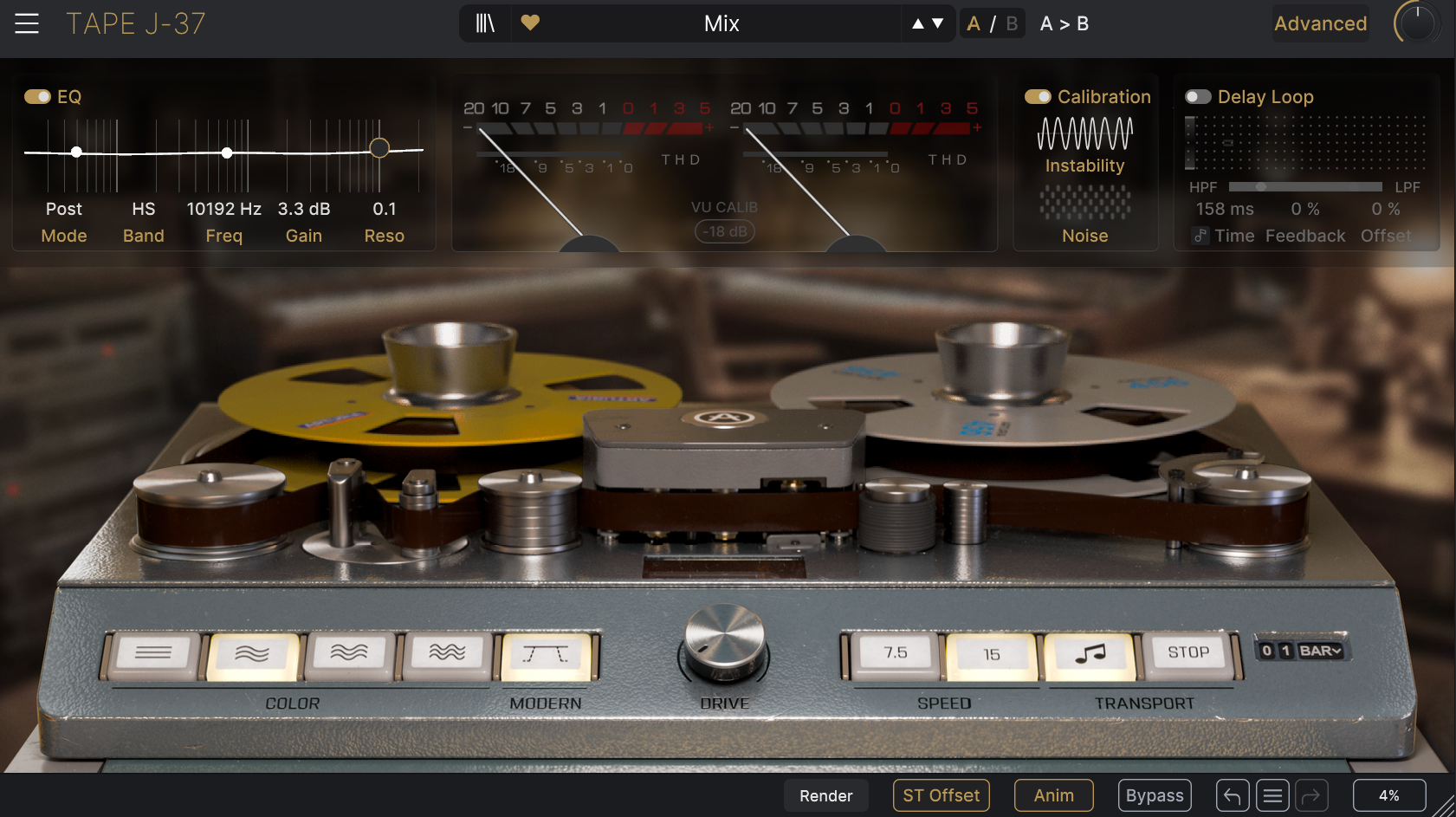
Next is another tape plugin but this one is more refined. I like to have the studio sound so this next one gives me that. I use two tape plugins, Sketch Cassette and J37 because I want it to sound like someone made a 4-track tape (why I use Sketch Cassette) and they brought it to the studio to be recorded (why I use J37). Many artists used to record demos or even full songs on 4-track cassette recorders at home and then bring those tapes to professional studios for further work. This was a common practice, especially from the 1980s through the early 2000s, when affordable home recording gear like the Tascam Portastudio and Fostex 4-tracks became widely available.
The Arturia J37 emulates the Studer J37 tape machine, a legendary analog tape recorder known for its use by iconic artists such as The Beatles, Pink Floyd, and Jimi Hendrix. I like this sound, and particularly the Tape Color 2 – Warm. This emulates new SM911 tape calibrated to NAB.
SM911 is a high-output, professional-grade analog reel-to-reel tape manufactured by Recording The Masters (RTM). It is designed for studio recording, mixing, mastering, and archival purposes, and is known for its warm analog sound, excellent clarity, high headroom, and low noise. SM911 is a direct successor to classic BASF/EMTEC tape formulations and is widely used in both professional and audiophile settings.
NAB (National Association of Broadcasters) equalization is the standard tape EQ curve used in North America. It is characterized by a transition frequency at 3150 Hz, a high-frequency boost (to compensate for tape head and tape losses), and a low-frequency “bass shelf” at 50 Hz (3180 μs time constant).
Together, the SM911 and NAB give a really nice warmth, and that is why I use the J37 plugin here.
I also use the J37’s VU meters calibrated to -18 dB to see my levels and I try to keep them hovering around the 0 mark.
Note: Sometimes I will put a different tape plugin here depending on what I need for a track.

Finally, Claro is just before the final metering and I use this on Mix (see below) in order to see where my instruments are clashing and to make adjustments accordingly. I really like the InvertEQ option, which allows me to simultaneously raise a point in one instrument while pulling down the same in another.
Claro really has been a game-changing plugin for me. It is not for everyone (maybe it should be, though), but it has helped me learn how to use my ears and not obsess over tiny details at first. Using the Produce setting first gets my mix sounding good and then I switch to Mix mode on the mix bus only, and see where different instruments are overlapping. Then I can adjust right there in Mix mode with an inverted EQ (usually) to simultaneously boost and cut two different but overlapping bands. Truly amazing how I can get rid of phase issues almost entirely in the Claro plugin.
